

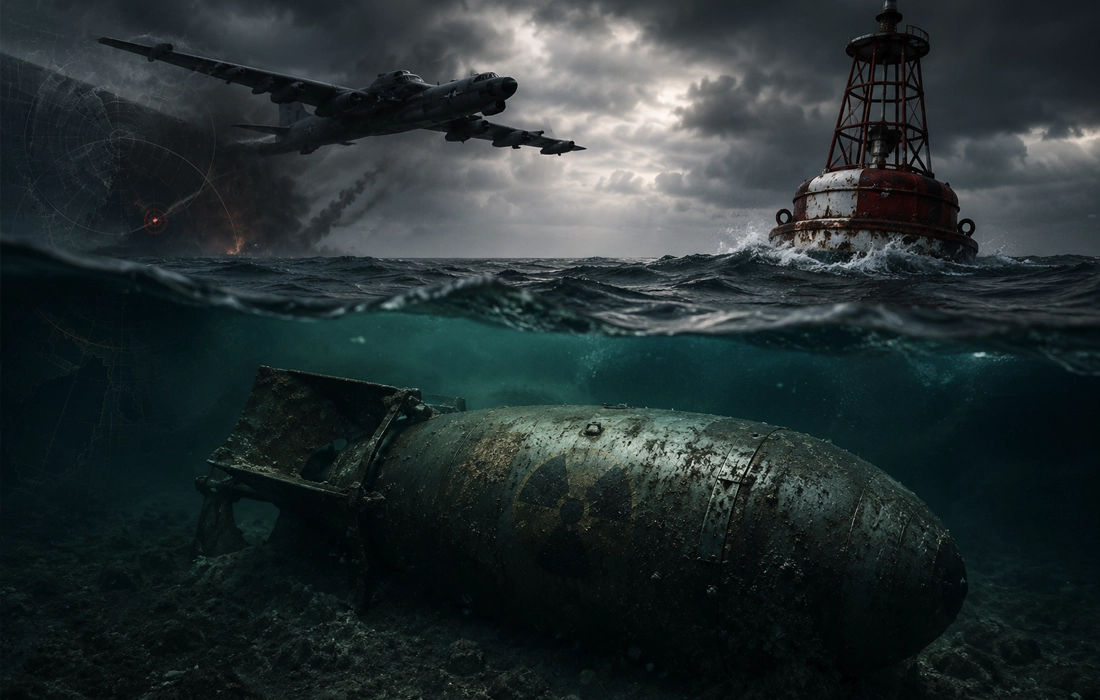

US lost nuclear bombs from past accidents remain missing, raising concerns about long-term risks and global security.
WASHINGTON: US lost nuclear bombs are back in focus, and the story sounds almost unbelievable. Decades after a series of accidents, several atomic weapons are still unaccounted for, scattered across oceans and remote locations.
These incidents, known as “Broken Arrow” events (By the same name and premise as the John Travolta starrer), refer to accidents involving nuclear weapons that do not trigger war. But even without detonation, the idea that bombs were lost and never recovered is enough to raise serious questions.
Massive jellyfish swarm halts French nuclear power plant
Out of 32 documented incidents, six nuclear weapons remain missing. The US position has long been that if it cannot find them, neither can anyone else. Still, the uncertainty continues to fuel concern.
One of the most talked-about cases dates back to 1958, when a US bomber dropped a hydrogen bomb off the coast near Georgia after a mid-air collision. Despite a large-scale search, the weapon was never recovered. Years later, declassified documents suggested it may have been fully intact.
Another incident in 1966 saw a thermonuclear bomb lost in the Mediterranean Sea after a collision between military aircraft. While some weapons were recovered, at least one warhead remains missing to this day.
India’s Kalpakkam fast breeder reactor reaches criticality in nuclear milestone
The US lost nuclear bombs cases highlight how even the most tightly controlled systems can face unexpected failures. While officials maintain there is no immediate threat, the long-term risks remain a topic of debate.
With global tensions rising and nuclear discussions back in the spotlight, these forgotten incidents are once again drawing attention, reminding the world that some Cold War-era secrets are still unresolved.
Broken Arrow
Broken Arrow is the flagword for nuclear weapon accidents, defined as unexpected events involving nuclear weapons, warheads or components that does not create a risk of nuclear war. These include:
- Accidental or unexplained nuclear explosion
- Non-nuclear detonation or burning of a nuclear weapon
- Radioactive contamination
- Loss in transit of nuclear asset with or without its carrying vehicle
- Jettisoning of a nuclear weapon or nuclear component
- Public hazard, actual or implied
Examples of these events include:
- 1950 British Columbia B-36 crash
- 1956 B-47 disappearance
- 1958 Mars Bluff B-47 nuclear weapon loss incident
- 1958 Tybee Island mid-air collision
- 1961 Yuba City B-52 crash
- 1961 Goldsboro B-52 crash
- 1964 Savage Mountain B-52 crash
- 1964 Bunker Hill AFB runway accident
- 1965 Philippine Sea A-4 incident
- 1966 Palomares B-52 crash
- 1968 Thule Air Base B-52 crash
- 1980 Damascus Titan missile explosion
Inputs: Wikipedia