

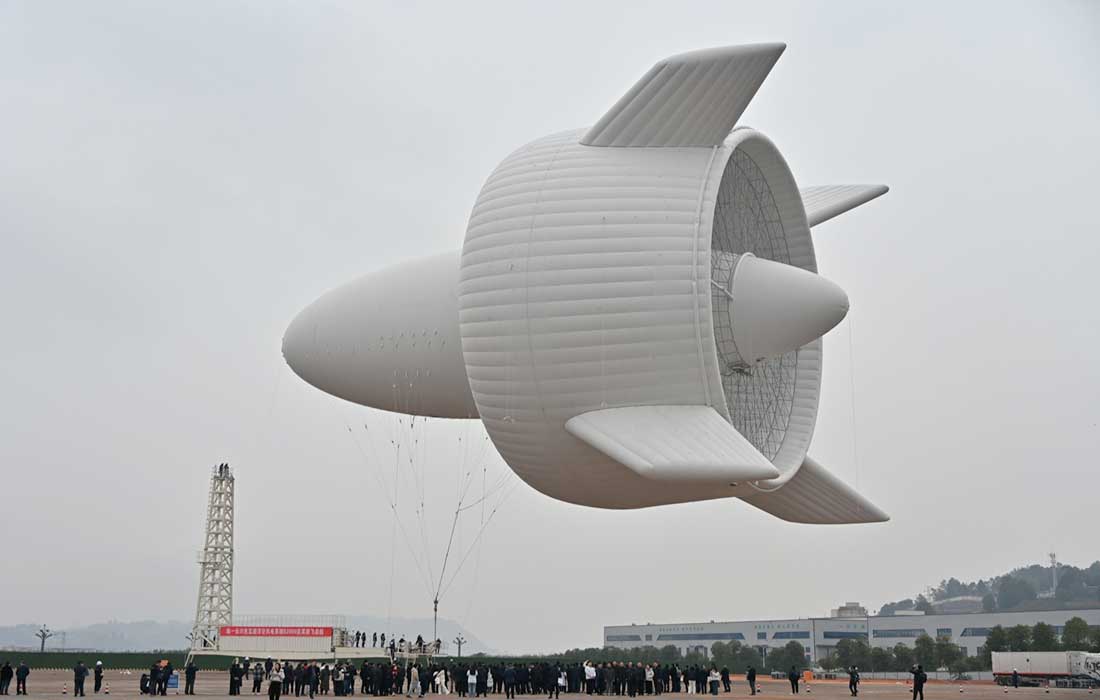

China’s S2000 airborne wind energy system completes high-altitude test flight, marking a breakthrough in urban wind power innovation.
YIBIN: A significant leap in sustainable energy was achieved this week as China successfully tested the world’s first megawatt-class high-altitude wind power system designed for urban use. Known as the S2000 Stratosphere Airborne Wind Energy System (SAWES), the test flight took place on Monday in Yibin, Sichuan Province, and represents a critical milestone in airborne renewable energy innovation.
The S2000 SAWES is a groundbreaking airborne wind turbine system that integrates a large-scale airship platform with wind turbines. Measuring 60 metres long, 40 metres wide, and 40 metres high, the structure is capable of operating at altitudes of up to 2,000 metres. During the test, it reached this target height in just 30 minutes and generated 385 kilowatt-hours of electricity — enough to fully charge approximately 30 premium electric vehicles in a single hour.
Crucially, the flight also marked the first time a high-altitude wind power unit was successfully connected to the power grid, moving China’s airborne wind energy technology from experimental phases into engineering-scale applications.
The project is spearheaded by Beijing-based start-up SAWES Energy Technology. Dun Tianrui, the company’s CEO and chief designer, noted the unit’s capability of generating up to 3 megawatts per device, making it a potential game changer for urban power solutions.
Experts highlight several environmental benefits of the SAWES platform, including reduced land usage and minimal ecological disruption when compared to traditional wind farms. These characteristics could make airborne systems ideal for urban and densely populated regions where space and sustainability are top priorities.
The successful demonstration opens doors to a future of urban-friendly, high-altitude renewable power systems that can be rapidly deployed and connected to national grids with minimal infrastructure impact.