

Dubai Metro Blue Line project advances as tunnelling begins, boosting connectivity and supporting long-term urban growth plans.
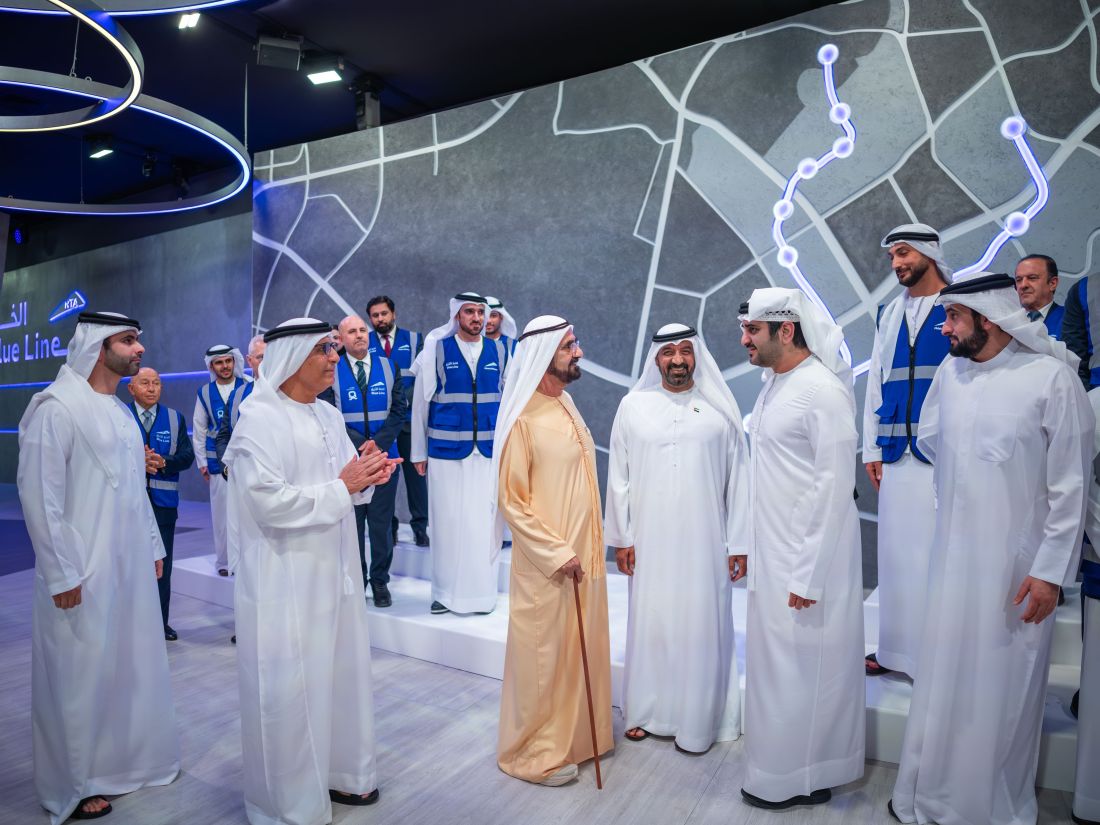
DUBAI: His Highness Sheikh Mohammed bin Rashid Al Maktoum, Vice President and Prime Minister of the UAE and Ruler of Dubai, launched the primary tunnelling works for the Dubai Metro Blue Line project, which involves an investment of over AED20.5 billion.
The 30-km route comprises a 15.5-km underground section and 14.5-km stretch above ground. It features 14 stations including three interchange stations, seven elevated stations and four underground stations. It will serve nine key districts with a projected population of around one million under the Dubai 2040 Urban Master Plan. His Highness also reviewed interior designs of the upcoming metro stations and was briefed on the project’s progress.
His Highness affirmed that investing in the transport sector is an investment in the future and a key pillar of enhancing Dubai’s global competitiveness. He noted that the Dubai Metro Blue Line represents an extension of an integrated vision aimed at building a more connected, efficient and sustainable city.
H.H. added: “Our projects in Dubai are delivered to meet the highest international standards, guided by clear plans, precise timelines, and national talent capable of turning vision into tangible achievements in practice. Their delivery is overseen by 180 railway experts and engineers.
The ceremony marking the formal inauguration of the tunnelling works was attended by H.H. Sheikh Maktoum bin Mohammed bin Rashid Al Maktoum, First Deputy Ruler of Dubai, Deputy Prime Minister and Minister of Finance of the UAE; H.H. Sheikh Ahmed bin Mohammed bin Rashid Al Maktoum, Second Deputy Ruler of Dubai; H.H. Sheikh Ahmed bin Saeed Al Maktoum, President of the Dubai Civil Aviation Authority, Chairman of Dubai Airports, and Chairman and Chief Executive of Emirates Airline and Group; H.H. Sheikh Mansoor bin Mohammed bin Rashid Al Maktoum, Chairman of the UAE Olympic Committee, and many senior officials.
The launch of tunnelling works for the Dubai Metro Blue Line from the largest underground interchange station in the metro network, spanning more than 44,000 square metres, reflects Dubai’s commitment to providing a smart mobility system that enhances quality of life, supports the movement of people and growth of businesses, and connects communities within an integrated urban framework, consolidating its position as the best city in the world to live, work and visit.
The project currently stands at 20% completion, with more than 10,000 workers deployed on the project and more than 500 engineers and experts overseeing delivery under Emirati leadership.
The consortium has completed more than 13 million work hours without recording any lost-time injuries. Construction works at the stations are progressing at an accelerated pace and have exceeded planned completion rates, reflecting the efficiency of execution. Bridge works are also ongoing, with foundations and piers being installed.
The consortium delivering the project has begun constructing the piers of the bridge crossing Dubai Creek, the first metro bridge to span the Creek, extending 1.3 km. The bridge structures are expected to begin taking shape next June.
In line with the project schedule, completion is expected to reach 30% by the end of 2026, with the project set to open on 9/9/2029.
Sheikh Mohammed gave the signal to start operating the Tunnel Boring Machine (TBM), which RTA has named ‘Al Wugeisha,’ marking the launch of tunnelling works for the Dubai Metro Blue Line. Tunnelling works will proceed in 3 directions from International City 1 Station, with the first TBM heading towards Mirdif, the second towards the Auto Market, and the third towards Al Warsan (International City 2).
Al Wugeisha tunnel boring machine is 163 metres long, weighs more than 2,000 tonnes, and operates around the clock. Its average excavation advance rate ranges from 13 to 17 metres per day.
The Dubai Metro Blue Line will connect with the Green Line at Creek Station and the Red Line at Centrepoint Station. It will serve residential communities, academic zones and major development areas expected to be home to around one million people by 2040.