


NRIs are urging India to revise the outdated duty-free gold jewellery limit in line with today’s high gold prices.
Dubai: With gold prices touching nearly INR 13,000 per gram in India and AED 508 per gram in Dubai, Non-Resident Indians (NRIs) across the UAE and other countries say they are facing growing challenges when travelling back home due to the outdated duty-free gold jewellery limits set by the Indian government. Many expatriates argue that the allowances prescribed nearly a decade ago no longer reflect the skyrocketing gold rates in 2025, resulting in inconvenience, confusion and, in some cases, harassment at Indian airports.
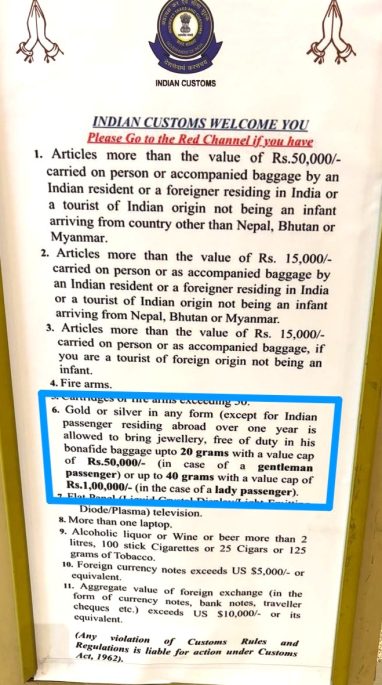
According to the Indian Embassy Abu Dhabi customs guide, an Indian citizen returning after more than one year abroad may carry up to 20 grams of gold jewellery worth INR 50,000 duty-free in the case of men, and up to 40 grams worth INR 1 lakh for women. NRIs point out that, at current prices, these values are no longer proportionate to the weight allowance mentioned in the rules. The prescribed value-to-weight ratio, they say, is practically irrelevant today.
Based on present gold values, INR 1 lakh translates to only around 7.5 grams of gold, and this quantity further reduces once jewellery making charges are factored in. For men, the entitlement falls to nearly half of that. NRIs argue that the duty-free allowance by weight has effectively shrunk by almost 70% in real terms.
The last major revision to India’s duty-free gold jewellery rules was implemented in April 2016, when gold was priced at approximately INR 2550 per gram. The duty-free limit for jewellery was increased at that time, but eight years later, as prices approach five times that level, the permitted gold quantity for passengers has fallen drastically when calculated by value.

In 2016, INR 50,000 corresponded to nearly 19 grams of gold, whereas today it equates to only around 7 grams. NRIs say that despite rising wages, inflation, travel frequency, and the natural cultural connection to gold during weddings and family ceremonies, the customs law has not evolved to meet present-day reality.
“We carry gold for personal and family use — not for trade”
Dubai-based businessman Chandrashekhar Bhatia, who has travelled between the UAE and India for over two decades, says the issue continues to worsen every year.
“For the past 25 years, every trip to Indore has become more complicated with gold jewellery. NRIs, especially women, carry jewellery either for personal wear or for gifting at weddings. The duty-free allowance is so low that even small household jewellery falls outside it. On top of that, people are questioned and sometimes harassed at airports despite carrying items meant purely for personal use.”
His sentiments reflect the concerns of many NRIs across the Gulf region, who say they are not demanding commercial exemptions, only practical and updated allowances that reflect today’s economic realities.
UAE-based organisation submits memorandum to Indian government
Amid growing frustration within the expatriate community, a UAE organisation recently formalised its request for clarity and revision. The Indian Association of Sharjah submitted a memorandum to Finance Minister Nirmala Sitharaman, seeking updated customs baggage declaration guidelines in view of current gold valuations.
Association President Nizar Thalangara stated:
“This is a major hurdle for NRIs, especially at airports. The rule was drafted almost a decade ago and does not reflect the current market situation. With gold at record highs, even small amounts attract heavy duty. The system needs a realistic update.”
Frequent UAE-based traveller Shahzad Alam says returning home with jewellery has become a stressful experience.
“We visit India every two or three years, and if we want to buy something for family or children, we hesitate because of the experience at airport checks. It affects our willingness to carry even simple gifts.”
Court guidelines exist — but incidents continue
In early 2025, the Delhi High Court ruled that personal, inherited or worn jewellery exceeding the duty-free limit should not be seized or treated as commercial goods, and customs officers were instructed to act in accordance with this until revised rules were introduced. Despite this interim legal relief, passengers continue to report difficulties during screening.
In one widely discussed case, 84-year-old Dubai-based businessman Vasu Shroff was detained for several hours at Jaipur Airport in April 2025 over a personal watch. Describing the ordeal, he said:
“I have lived in Dubai for more than 60 years and travelled to India over 100 times. Visiting home should bring pride, not humiliation. Instead, I was made to feel like a criminal for my own belongings.”
“How will India promote destination weddings if jewellery rules remain restrictive?”
NRIs also point out the contradiction between India’s ambition to boost tourism and wedding-related travel, and the restrictive customs regulations that limit jewellery carried for such occasions.
Dubai resident Nilesh Jain commented:
“Prime Minister Narendra Modi urges families to choose India for destination weddings. But if brides, grooms and guests cannot bring their own jewellery without fear of penalties, how will they choose India over other countries? The government should consider separate policies for NRIs, tourists and transit passengers.”
“I carry artificial jewellery to avoid trouble at arrivals”
For many women, the concerns are even more personal. Dubai resident Veena shared how she avoids wearing gold to India to prevent airport disputes.
“The allowance is so low that for family weddings I am forced to wear artificial jewellery. How do we prove that inherited jewellery belongs to us if we don’t have decades-old receipts? The government should allow personal gold to be logged at arrival and verified again upon exit.”