

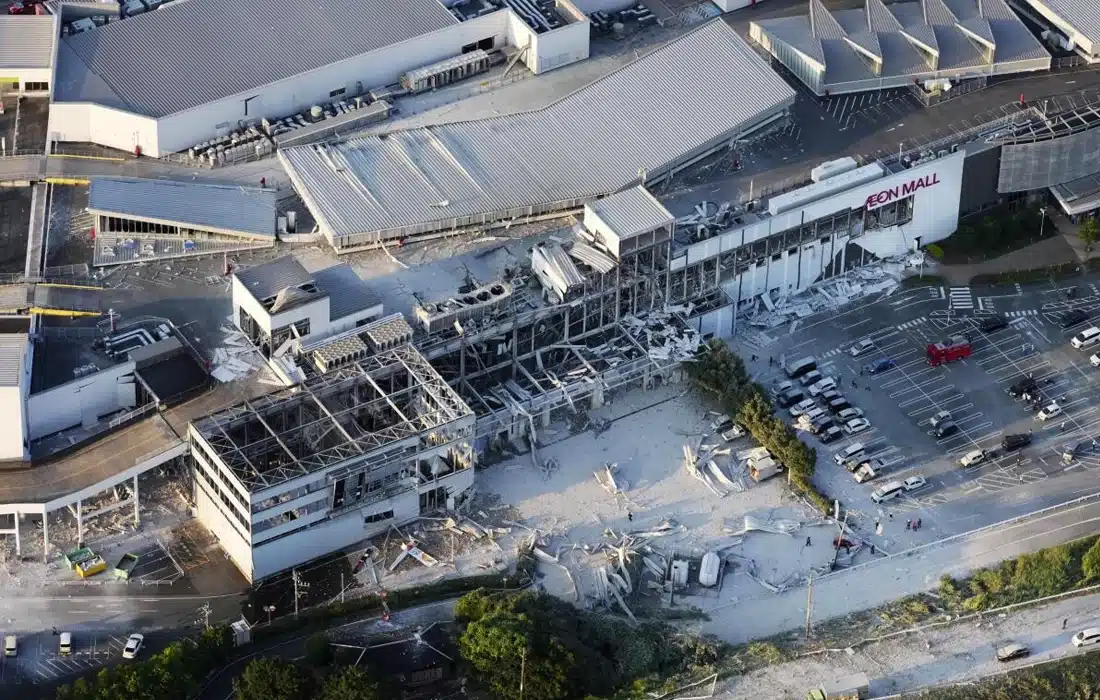

A powerful Japan earthquake struck Kumamoto Prefecture, leaving at least one person dead, more than 100 injured and triggering a major rescue operation after part of a shopping mall collapsed.
TOKYO: Rescue teams are racing against time after a powerful Japan earthquake struck the country’s southern Kyushu island, killing at least one person, injuring more than 100 others and trapping people inside a damaged shopping mall.
The magnitude 6.8 earthquake hit Kumamoto Prefecture on Tuesday afternoon, causing widespread damage to buildings, roads and bridges while knocking out electricity to around 48,000 homes. Authorities also reported dozens of aftershocks following the main quake, prompting warnings of further landslides and structural collapses.
READ ALSO: How does Japan’s new AI detector identify human-written content?
One of the worst-hit locations was an Aeon shopping mall, where an explosion and partial collapse left several people trapped. Emergency crews worked through the night searching for survivors, with officials saying around 10 people remained unaccounted for. Earlier reports suggested between 20 and 30 employees could not be contacted immediately after the disaster.
Japanese Prime Minister Sanae Takaichi said the government was fully focused on rescue operations and urged residents to move to safe locations. Around 300,000 people were advised to evacuate as authorities warned that the shallow quake could trigger more powerful aftershocks over the coming days.
Hospitals across the region treated more than 100 injured people, including several in serious condition. Local media reported that some medical facilities experienced water leaks and electrical failures while continuing to receive a steady stream of patients.
The earthquake also disrupted transport and business operations across Kyushu. High-speed bullet train services were suspended, Kumamoto Airport temporarily closed its runway, and several major manufacturers, including Sony, TSMC and Fujifilm, evacuated workers from nearby facilities as a precaution. Authorities confirmed there were no abnormalities at nuclear power plants in the region.
READ ALSO: Japan nuclear restart begins at Kashiwazaki-Kariwa power plant
Japan’s Self-Defence Forces deployed about 3,600 personnel and 20 aircraft to support rescue and damage assessment efforts. Telecommunications services were also affected in some areas because of power outages and damaged transmission lines.
The quake revived memories of the devastating 2016 Kumamoto earthquakes, which claimed hundreds of lives and caused widespread destruction across the prefecture. Officials are continuing to assess the full extent of the latest damage, while rescue operations remain the top priority.
Japan is one of the world’s most earthquake-prone countries because it sits on the Pacific “Ring of Fire”, where several major tectonic plates meet. The country experiences thousands of earthquakes every year, with many too small to be felt, while stronger quakes can trigger devastating tsunamis. The most catastrophic in recent history was the magnitude 9.0 earthquake and tsunami in March 2011, which left around 18,500 people dead or missing and caused the Fukushima nuclear disaster. As a result, Japan has some of the world’s most advanced earthquake monitoring systems, strict building standards and regular disaster preparedness drills to minimise the impact of future seismic events.

Shaneer N. Siddiqui is the Managing Editor at TheBrewNews.com, with more than 20 years of experience in journalism, media, communication, and business strategy. A lifelong news enthusiast, he enjoys telling stories that inform, engage, and matter. Whether he’s following the latest developments or guiding the editorial team, Shaneer stays focused on bringing readers meaningful news. Outside the newsroom, he likes reading, exploring new ideas, and staying curious about the changing world of media.
Connect with him to follow his latest work and insights.