

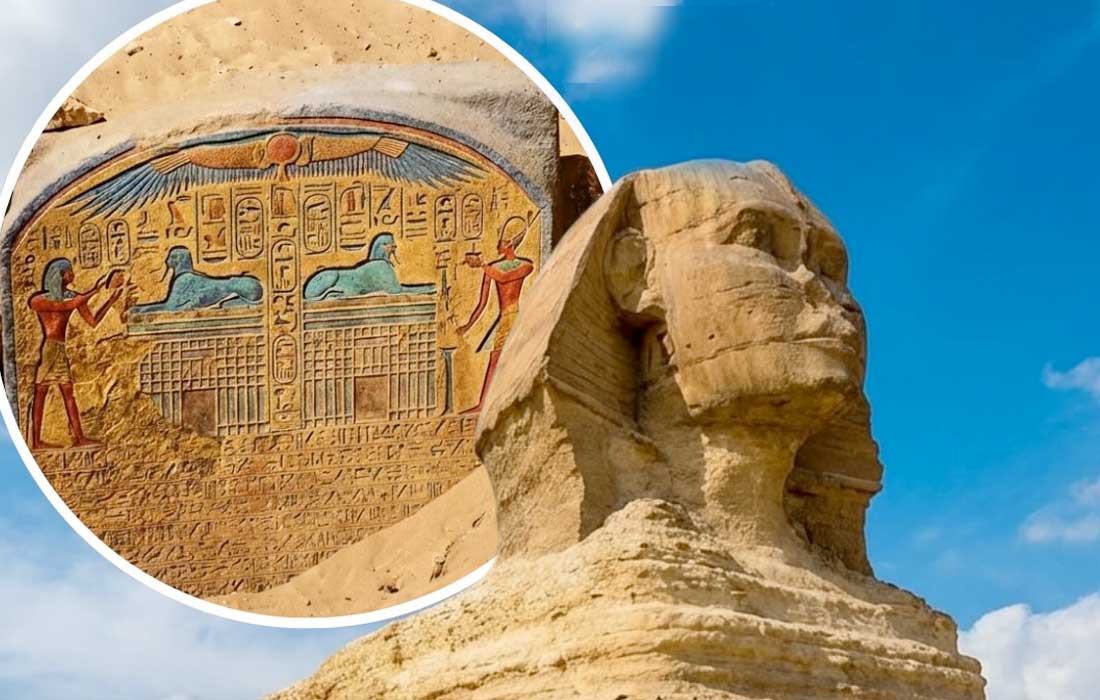

Researchers using advanced radar technology have detected underground structures at Giza that mirror the Great Sphinx almost perfectly, with Italian researcher Filippo Biondi revealing geometric alignments pointing to a possible buried second Sphinx that could rewrite Egyptian history.
CAIRO: One of the most iconic monuments on Earth may have a twin buried just beneath the surface, and if the latest research is confirmed, everything we thought we knew about ancient Giza is about to change.
A new wave of subsurface scans has produced findings that have the archaeological world buzzing. Researchers say the data points to a structure buried beneath the sands of Giza that mirrors the Great Sphinx almost perfectly in size and geometry, hinting at the existence of an underground megastructure far larger and more complex than anyone had previously imagined.
Italian researcher Filippo Biondi has been at the forefront of the investigation, revealing that geometric alignments running from the pyramids point to a precise mirrored location beneath the plateau. Advanced radar technology deployed at the site has detected vertical shafts, dense underground patterns, and wall-like formations consistent with a buried monumental structure. The precision of the alignments, he argues, is too exact to be coincidental.
The Great Sphinx of Giza, already one of the most enigmatic structures in human history, has long been surrounded by theories about hidden chambers, tunnels, and undiscovered monuments beneath the plateau. Previous investigations have hinted at anomalies below the surface, but nothing has approached the scale and specificity of what the latest scans appear to be showing.
If a second Sphinx does lie beneath the Giza sands, the implications would be extraordinary. It would suggest that the ancient Egyptians conceived of the Giza complex as a symmetrical, mirrored design of far greater ambition than its visible surface reveals. It would raise profound questions about what else remains hidden, what purpose a buried twin Sphinx might have served, and how much of the ancient world is still waiting to be found.
The findings have not yet been independently verified or subjected to full peer review, and archaeologists are appropriately cautious about drawing firm conclusions from radar data alone. Excavation and further investigation will be needed before any definitive claims can be made.
But in the world of ancient history, few sentences carry as much weight as these: there might be another one, and it has been there all along.