

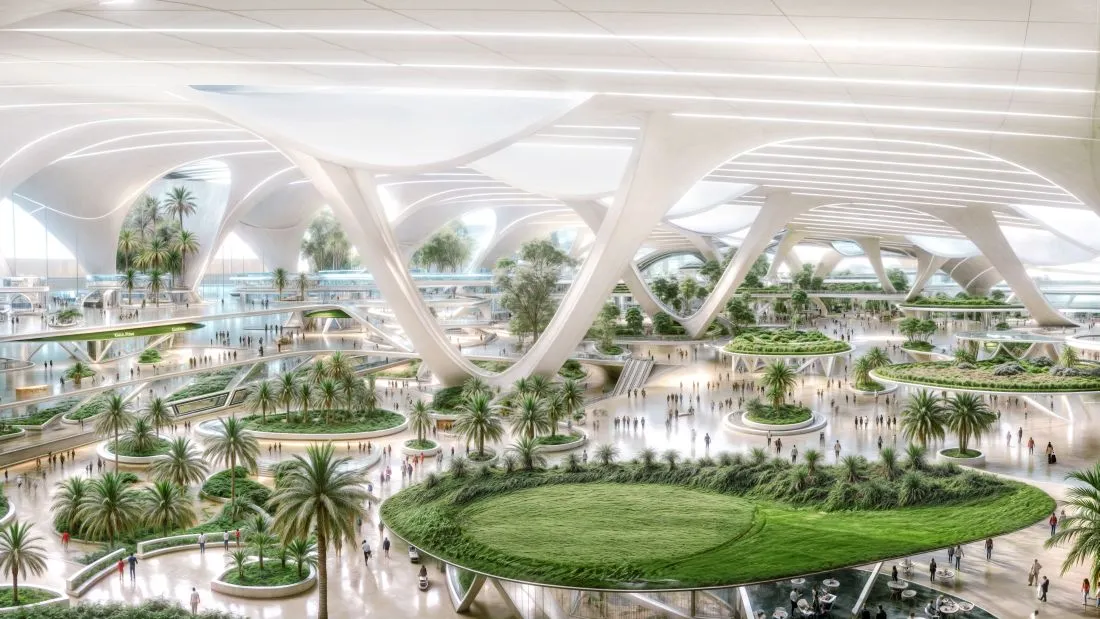

Dubai says the first phase of the Al Maktoum Airport project is progressing on schedule, with major construction milestones achieved. The development is expected to boost aviation capacity, strengthen logistics networks and support the emirate’s long-term economic ambitions.
DUBAI: Why is the Al Maktoum Airport project considered one of the most important developments in Dubai’s future?
The answer lies in its scale, ambition and strategic role in supporting the emirate’s long-term economic vision. Dubai has confirmed that the first phase of the Al Maktoum Airport development is progressing according to schedule, with significant milestones already achieved across several key construction and infrastructure packages.
Officials say the project remains on track to begin operations in 2032, marking a major step towards creating what is expected to become the world’s largest aviation hub.
The Al Maktoum Airport project has already recorded substantial progress. Construction teams have completed major enabling works, advanced runway infrastructure and laid the initial structural foundations for passenger terminals and aircraft gates. More than 17,000 concrete piles have been installed, while excavation works have surpassed 45 million cubic metres.
According to Dubai Aviation Engineering Projects, over 10 million work hours have been completed during the past 15 months. The current workforce of around 9,000 people is expected to increase dramatically to approximately 120,000 workers during peak construction activity.
The Al Maktoum Airport project is a key component of Dubai’s long-term growth strategy. Officials believe the development will support the objectives of the Dubai Economic Agenda D33 by expanding aviation capacity, enhancing logistics efficiency and attracting new investments across multiple sectors.
Speaking about the project, H.H. Sheikh Hamdan bin Mohammed bin Rashid Al Maktoum said the airport reflects Dubai’s ambition to build advanced infrastructure capable of supporting sustainable economic growth and strengthening the emirate’s position as a globally connected city.
The next stage of development is expected to accelerate significantly. Preparations are underway to award major contracts worth more than AED55 billion by the end of the year. These packages include passenger terminal structures, aircraft concourses, baggage handling systems, automated transport systems and supporting infrastructure.
Once completed, the Al Maktoum Airport project will have the capacity to handle more than 260 million passengers annually and process up to 12 million tonnes of cargo every year. The airport will feature five independent parallel runways, two passenger terminals and seven concourses connected to more than 430 aircraft stands.
A major focus of the development is future-ready technology. The airport is being designed as a highly integrated aviation ecosystem featuring advanced automation, intelligent operational systems and seamless connectivity between air, road and rail transport networks.
Officials say these innovations will help deliver a smoother passenger experience while increasing operational efficiency and supporting future growth in global travel and trade.
The project also forms part of a broader aviation infrastructure programme across Dubai. Alongside work at Dubai World Central, major upgrades are continuing at Dubai International Airport, including improvements to terminals, road access, airfield operations and baggage handling facilities.
As construction momentum continues to build, the Al Maktoum Airport project is increasingly being viewed as a transformative investment that could redefine aviation in the region. By combining scale, technology and connectivity, Dubai aims to create an airport capable of meeting global demand for decades while reinforcing its status as one of the world’s leading hubs for tourism, logistics, trade and international business.