

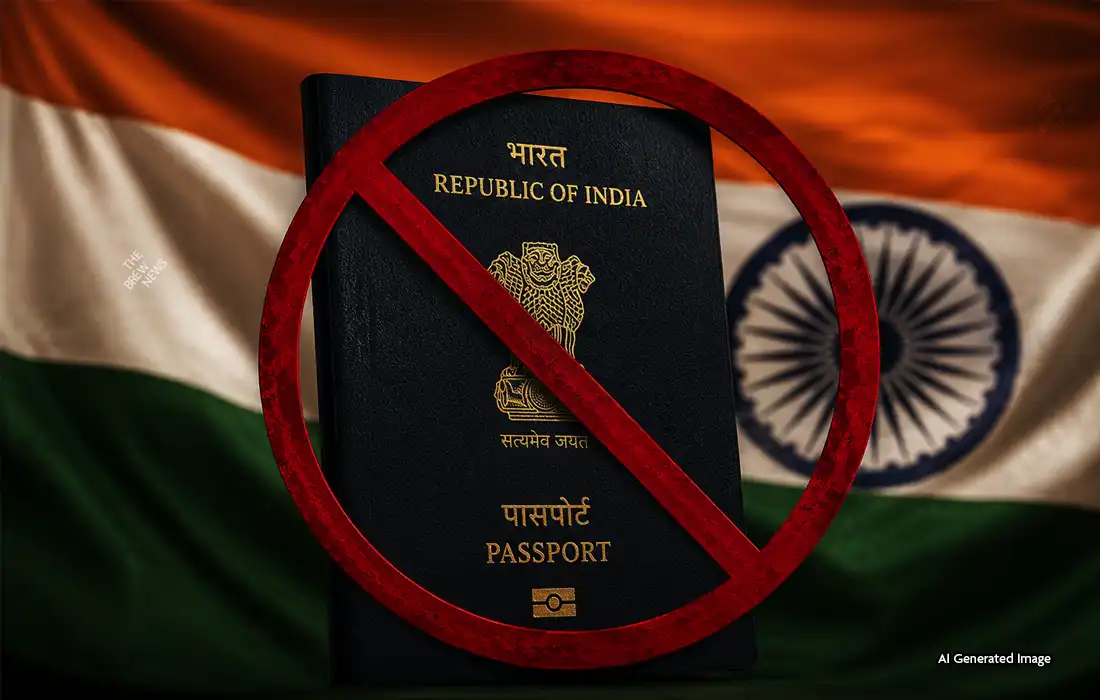

Indian passport citizenship rules are back in focus after the government clarified that a passport is a travel document, not conclusive proof of citizenship.
NEW DELHI: If you’ve always believed your Indian passport is proof of citizenship, the government says that’s not entirely correct.
The clarification came during the 14th Passport Seva Divas, when the Ministry of External Affairs (MEA) said a passport is primarily a travel document issued after extensive verification, but it is not conclusive legal proof of citizenship.
The issue has gained attention after the Supreme Court recently observed during hearings on the Special Intensive Revision of voter rolls that Aadhaar is an identity document but does not establish citizenship. The government’s latest remarks have now brought Indian passport citizenship into the spotlight.
To explain its position, the Centre pointed to Section 20 of the Passports Act, 1967. The law allows the Central Government to issue a passport or travel document to a person who is not an Indian citizen if doing so is considered necessary in the public interest. According to the government, this provision makes it clear that possessing a passport alone does not legally establish citizenship.
Officials also stressed that this is not a new policy. They said no recent decision has changed the status of passports and that the legal position has remained the same for years. The government also cited a 2013 Bombay High Court judgment, which held that simply holding a passport does not prove Indian citizenship.
The Passports Act, 1967, governs the issuance of ordinary, official and diplomatic passports, along with emergency travel documents and certificates of identity. It also sets out the conditions under which passport authorities can refuse to issue or endorse passports.
The clarification has sparked political debate and widespread discussion online. While a passport remains one of India’s most important official documents for international travel, the government maintains that Indian passport citizenship must be determined under the country’s citizenship laws and not by possession of a passport alone.
Indian passport and citizenship: Key points explained:
- An Indian passport is primarily a travel document, not conclusive proof of Indian citizenship.
- The clarification was issued by the Ministry of External Affairs (MEA) during the 14th Passport Seva Divas.
- The government says passports are issued after extensive verification, but that does not automatically establish citizenship.
- The Centre cited Section 20 of the Passports Act, 1967, which allows passports to be issued to non-citizens in certain cases if it is in the public interest.
- The clarification follows the Supreme Court’s recent observation that Aadhaar is an identity document and not proof of citizenship.
- The government also referred to a 2013 Bombay High Court judgment, which held that possessing a passport alone does not prove citizenship.
- The Passports Act, 1967 governs the issuance of ordinary, official and diplomatic passports, along with other travel documents.
- According to the government, no new rule has been introduced. This legal position has remained unchanged for years.
- Citizenship in India is determined under the Citizenship Act and other applicable laws, not solely by holding a passport.