

Tesla Cybercab is now giving driverless rides in parts of Austin, with passengers sitting inside a two-seat taxi that has no steering wheel or pedals.
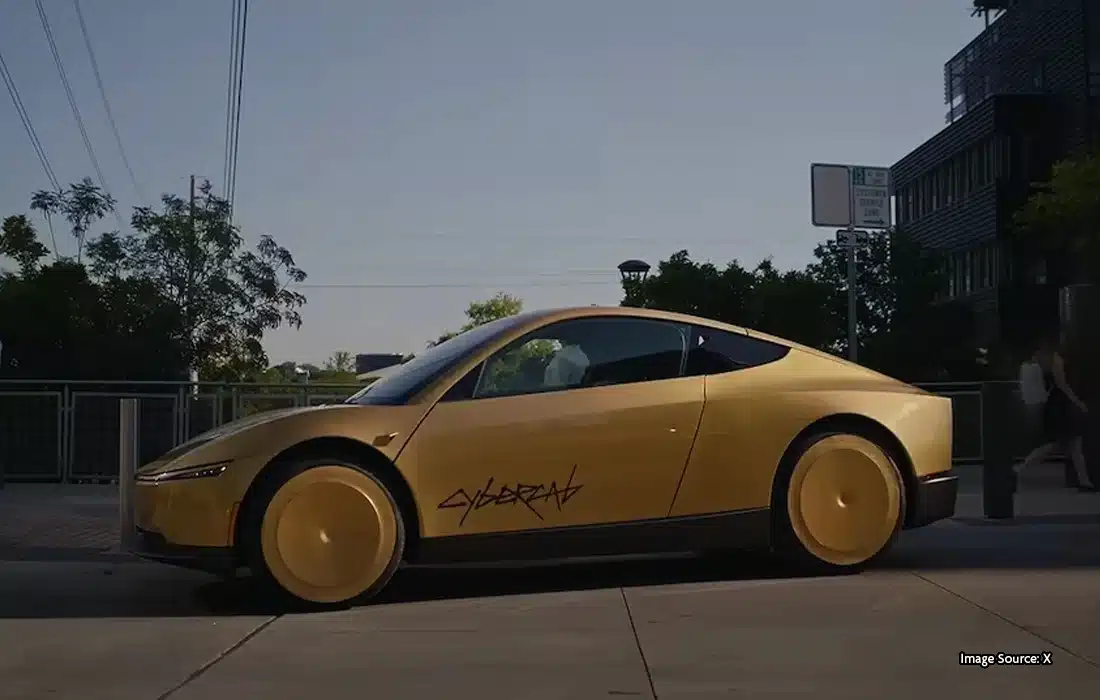
AUSTIN: Imagine getting into a taxi, closing the door and realising there is no steering wheel or brake pedal. That is now a real experience for some passengers in Austin, Texas, where Tesla has started offering rides in its purpose-built Cybercab also called Robotaxi. The gold-coloured, two-seat robotaxi has been designed from the beginning to drive itself, with no traditional driving position inside.
Cybercab is engineered to be the safest car on the road pic.twitter.com/EQMROaMk2E
— Tesla (@Tesla) September 3, 2026
The Tesla Cybercab is currently operating in limited parts of Austin through Tesla’s existing Robotaxi service. It marks a major change from the company’s earlier robotaxi operations, which mainly used modified Model Y vehicles that still had normal driving controls. Reuters reported that 45 Cybercabs were registered in Texas as Tesla prepared for the rollout.
Yes, we are indeed entering a literal golden era of transport 😂
— Elon Musk (@elonmusk) September 3, 2026
That’s why Cybercab is gold! https://t.co/o5eDVN1fC9
For passengers, the biggest difference is simple: there is no way to grab the wheel if something goes wrong. The vehicle depends on Tesla’s autonomous driving technology, with remote support available rather than a driver sitting inside.
The future of transport is safer, more enjoyable & gives you more time back
— Tesla (@Tesla) September 3, 2026
With theater, music & gaming apps on a 22" touchscreen, Cybercab offers you a space to be productive or unwind
Soon to be equipped with V5 Starlink hardware, too, for complete connectivity pic.twitter.com/e0Xhvjky0E
Tesla has taken a different technical route from several of its biggest self-driving rivals. Its system relies heavily on cameras, onboard computers and neural networks rather than the combination of cameras, radar and lidar used by some competitors. Tesla argues that its vision-based approach can eventually make autonomous transport simpler and cheaper.
Cybercab is designed to be a great experience for every rider pic.twitter.com/wG0jrvJ6pX
— Tesla (@Tesla) September 3, 2026
The Tesla Cybercab itself is also very different from a normal car. It has only two seats and was created specifically for ride-hailing rather than being adapted from a vehicle designed for private owners. Production began earlier in 2026, although Elon Musk previously warned that initial Cybercab production would be slow.
The Austin service is still limited, so Cybercabs are not suddenly roaming every street in the city. Tesla has also not provided a firm timetable for when the steering-wheel-free service will become widely available across the US.
And there is another big question: regulation.
Also read: Elon Musk’s $1 trillion Tesla payout: too bold to believe?
The US National Highway Traffic Safety Administration is examining whether the unusual vehicle complies with federal safety requirements. The lack of a steering wheel, brake pedals and conventional mirrors has put particular attention on how Tesla certified the Cybercab for public roads.
Cybercab is democratizing clean transportation for all pic.twitter.com/Raz5dy2Q3Z
— Tesla (@Tesla) September 3, 2026
That scrutiny matters because Tesla’s Full Self-Driving software offered to private vehicle owners is still a supervised driver-assistance product. Cybercab takes the idea much further because passengers do not have traditional controls available to take over.
The Tesla Cybercab therefore represents one of the clearest tests yet of whether people are ready to trust a car that gives them a ride without giving them the option to drive it.
Impact to expect
If Cybercab proves safe and reliable, it could change how people think about taxis. Removing the steering wheel, pedals and driver could eventually help Tesla lower operating costs and build vehicles specifically around passengers rather than drivers.
But the Austin launch also puts more pressure on Tesla to prove that its technology works safely in everyday traffic. Regulators are watching, competitors are developing their own driverless services, and passengers now have to decide whether they are comfortable getting into a car where the software is completely in charge.