

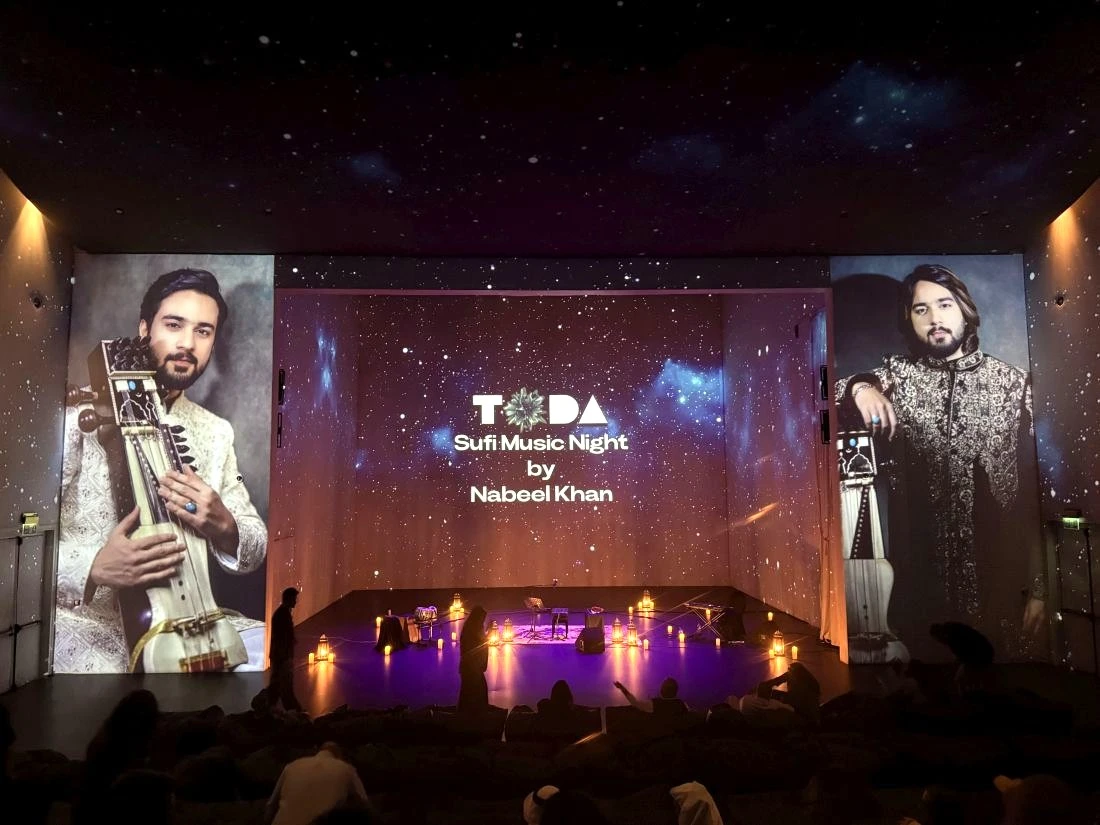

A mesmerising evening at Dubai’s Theatre of Digital Art saw renowned sarangi artist Nabeel Khan blend traditional Sufi melodies with immersive digital visuals, introducing new audiences to the timeless beauty of the sarangi while preserving its rich heritage.
DUBAI: When a uniquely eclectic mix of Dubai audience gathered at the Theatre of Digital Art on Friday, they expected soulful acoustics and Sufi music that has thrived for ages. What they ended up witnessing was a traditional Indian classical music instrument, the Sarangi, transcending art forms and traditions to create a playlist spanning genres. Sarangi player Nabeel Khan is young by the age-old standards of the classical gharana traditions, but to him goes the credit of blending classical music with the rigors of time and dishing out performances that suit the digital mould for audiences of diverse tastes.
Across generations
Nabeel belongs to the eighth generation of Sarangi artists in his family and is the son of Ustad Nasir Khan Saheb and grandson of the legend Padma Bhushan awardee Ustad Sabri Khan Saheb. He belongs to the much-revered Moradabad Sainia Gharana of Sarangi players. The instrument, Sarangi, admittedly an amalgamation of Sau Rang (a hundred colors), has also stood the test of time and gone places. Nabeel calls the sarangi, the 39-stringed instrument, “the closest instrument to human voice,” and the only instrument played with a bow. He endearingly and jokingly calls it a “lady” instrument because it is difficult to tune. “Ek din nahi bajaaoon to naaraz hi jaati hai (it sulks if you don’t play it for a day).” He, however, hastened to add, “Once it gets going, there is no stopping the sarangi.”
Vocals and strings
What unfolded on Friday was a series of tracks from the South Asian Sufi music repertoire, interspersed with occasional Bollywood hits. Starting with the evergreen Sufi classic Man Kunto Maula to Dama Dam Mast Qalandar and the effervescent Nusrat Fateh Ali Khan qawwalis such as Saanson ki Maala and Dil Pe Zakhm Khaate hain. Nabeel also combined singing with playing the sarangi, culminating in the rendition of Tajdaar-e-Haram, a qawwali first immortalized by the Sabri brothers.
The light and sound design provided the perfect tapestry during the show, with the twirling dervish keeping company.
The immersive experience gained another dimension when Nabeel recommended that the audience listen to the sarangi as they went to sleep for its sukoon (serenity) and therapeutic value.
Nabeel is 26 years old and has been playing the instrument since age 7, even though he wanted to become a table player. His three functional cuticles have taken a heavy toll, but have also made him a global face associated with the advancement of the sarangi.
Nabeel looks like a man on a mission to popularize sarangi, and he is succeeding in his endeavors because he has put the craft before the persona, a unique and mature approach that is rare to see.