

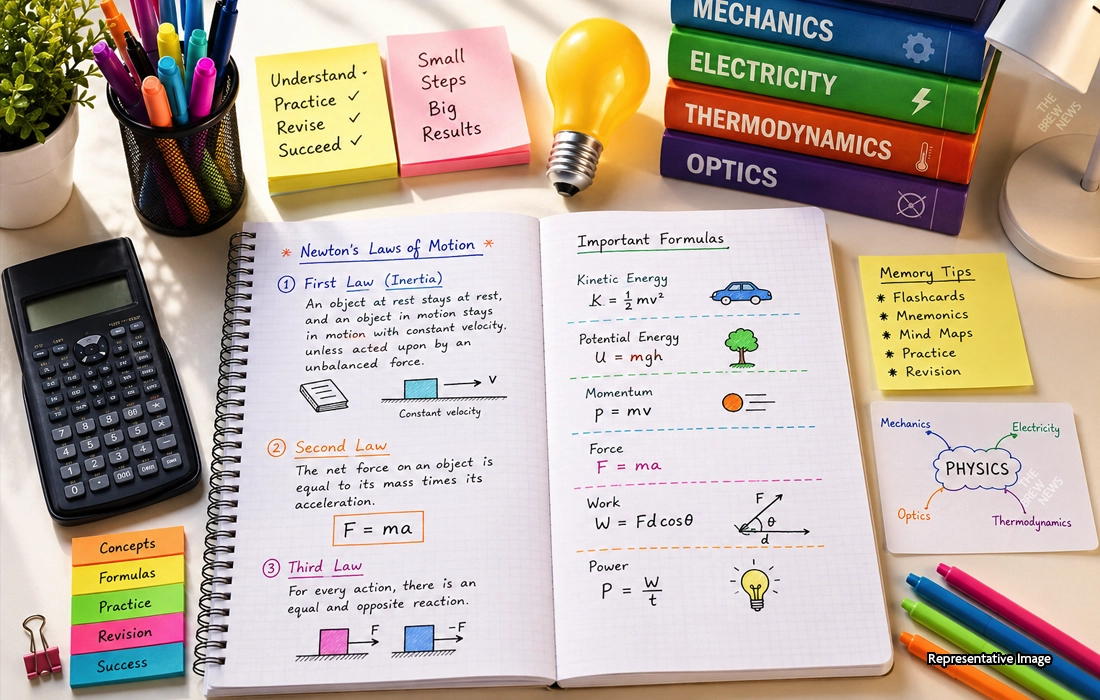

Learning physics formulas becomes easier when students focus on concepts, regular practice and visual memory techniques rather than rote memorisation alone.
Understanding physics becomes much easier when concepts are organised logically and studied with consistency. Continuing from Part 1, this article explores practical techniques that can help students simplify physics formulas, improve memory and develop a stronger grasp of the subject.
The late Anglo-Irish philosopher and writer Edmund Burke famously said, “Good order is the foundation of all things.” The same principle applies to physics. Instead of trying to memorise dozens of unrelated formulas, students should organise them according to topics such as mechanics, electricity, optics and thermodynamics. This approach helps reduce confusion and makes it easier to identify the correct formula when solving problems.
Sports and Physical workouts play a vital role in Memory Development
Equally important is understanding the meaning behind each formula. Rather than memorising equations mechanically, students should learn what each variable represents, how the formula is derived and where it is applied. A clear conceptual understanding makes formulas far easier to remember and use correctly.
Learning physics is a gradual process. Effective study strategies include mastering the basic concepts first, practising a wide variety of numerical problems, using visual learning tools such as educational videos, diagrams and mind maps, and following a regular study schedule. Since mathematics is the language of physics, developing strong mathematical skills is essential for success.
Students should also remember that introductory physics is designed to familiarise them with the language and principles of the subject. Physics is a vast discipline, and true understanding develops over time. Patience and steady progress are far more effective than trying to master everything at once.
Muscle-strengthening activities for kids that boost memory and development
One of the greatest contributions to physics came from Sir Isaac Newton, whose Three Laws of Motion continue to form the foundation of classical mechanics.
- First Law (Law of Inertia): An object remains at rest, or continues moving at a constant velocity, unless acted upon by an external unbalanced force.
- Second Law: The net force acting on an object equals its mass multiplied by its acceleration (F = ma).
- Third Law: For every action, there is an equal and opposite reaction. Forces always occur in equal and opposite pairs.
Memory enhancement techniques
Students can improve recall of physics formulas by using proven memory techniques:
- Flashcards: Write the formula on one side and its meaning, application or a mnemonic on the other for quick revision.
- Formula sheets: Prepare a list of formulas and rewrite each equation multiple times. Repetition strengthens long-term memory.
- Mnemonics: Create memorable acronyms or word associations to connect variables and formulas.
Physics also introduces students to fascinating advanced topics such as quantum gravity, one of the greatest unsolved challenges in modern science. Researchers continue to seek a theory that successfully combines gravity with quantum mechanics into a single framework.
Proper visualization a must for an enhanced memory
Eight fundamental steps to memorise physics formulas
- Understand the basic theories before attempting to memorise equations.
- Strengthen mathematical skills, as mathematics is essential to physics.
- Ask relevant questions whenever concepts are unclear.
- Write notes by hand instead of relying entirely on digital devices.
- Practise solving physics problems consistently.
- Divide large topics into smaller, manageable sections.
- Associate formulas with familiar locations using memory techniques such as the memory palace method.
- Revise newly learned concepts within eight hours to reinforce long-term retention.
Learning physics is not about memorising hundreds of equations. It is about understanding the ideas behind them, practising regularly and building knowledge step by step. With discipline, curiosity and the right study methods, physics becomes not only easier to learn but also enjoyable to explore.
Brain Booster: Enhance your memory by employing the Link System

About the writer:
Minoo Jokhi is a fun-loving mathemagician and memory trainer based in Mumbai, India. He teaches people from age 4 to 80 how to boost their memory and proves that memory isn’t something you’re just born with, it’s something you can actually train.
If you’d like to get in touch, you can email him at minoojokhi@rediffmail.com or check out his work at minoojokhi.in