

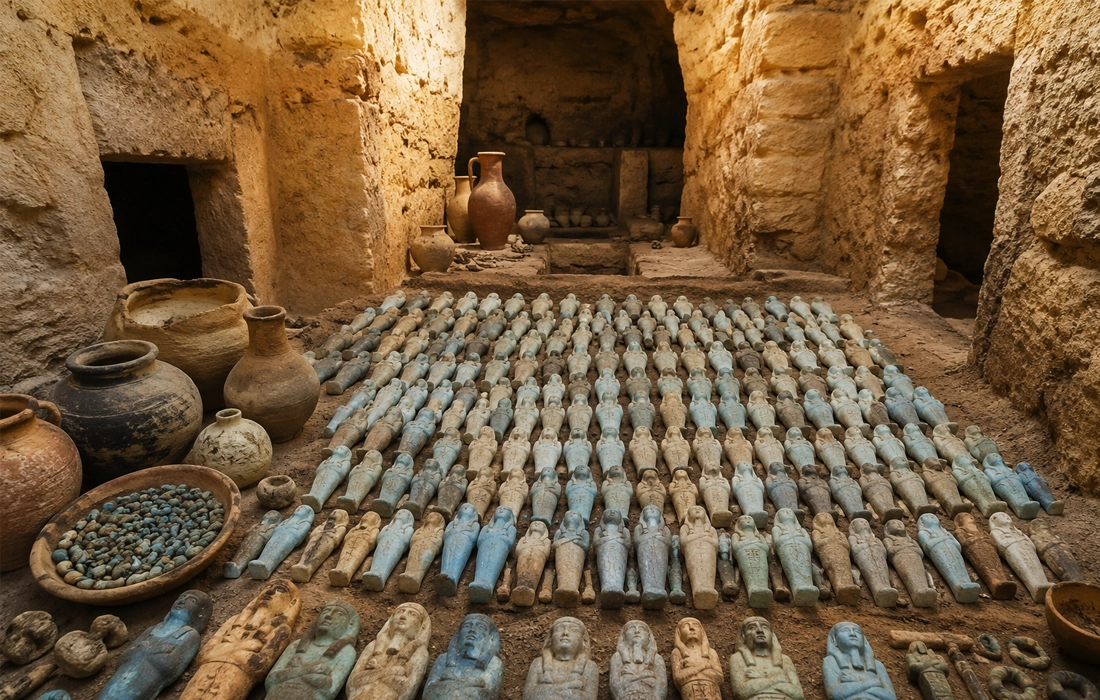

A newly discovered Nile Delta tomb in Egypt has revealed 560 funerary figurines, imported artefacts and evidence that is helping archaeologists better understand ancient burial customs and Mediterranean trade.
CAIRO: Why is the latest Nile Delta tomb discovery attracting the attention of archaeologists? Egypt’s Ministry of Tourism and Antiquities has announced the excavation of a previously unknown funerary unit at the Tell Quesna archaeological cemetery in Menoufia Governorate. The discovery provides valuable evidence about burial traditions, religious beliefs and international trade during the Late and Greco-Roman periods.
Grand Egyptian Museum becomes first green museum in MENA region
The excavation was carried out by an Egyptian archaeological mission from the Supreme Council of Antiquities. Researchers uncovered a funerary complex consisting of a central burial hall connected to several chambers through vaulted entrances. Human remains were found laid in Osirian burial positions, a practice linked to Osiris, the ancient Egyptian god associated with the afterlife and resurrection. The layout of the tomb and its contents are expected to help experts understand how funerary practices evolved during this period.
One of the most significant discoveries inside the Nile Delta tomb was a collection of 560 ushabti figurines. Ushabtis were small statues placed in tombs to serve the deceased in the afterlife, according to ancient Egyptian beliefs. Several figurines carry inscriptions taken from the Book of the Dead, a collection of funerary texts intended to guide and protect individuals on their journey after death.
Hidden Egyptian royal tomb uncovered behind false door
Archaeologists also recovered protective amulets, pottery vessels and large quantities of faience beads. One pottery container still contained residues that specialists believe may have been used during mummification or funeral ceremonies. These artefacts are now undergoing scientific analysis to determine their composition and purpose, offering further insight into ancient Egyptian rituals.
Another important aspect of the excavation was the discovery of imported pottery originating from the Greek island of Rhodes. The presence of these vessels confirms that Egypt maintained active commercial links with the wider Mediterranean world during the Late and Greco-Roman periods. Such imported objects also demonstrate how trade influenced local communities and funerary traditions.
Tamil Brahmi inscriptions found in Egypt: Did Tamils visit Egypt 2,000 years ago?
Sherif Fathi Attia, Egypt’s Minister of Tourism and Antiquities, said the discovery offers fresh insights into both the religious and economic life of the era. Archaeologists also identified unusual burial features that remain under study and could reshape current understanding of the Tell Quesna cemetery.
The Nile Delta tomb excavation highlights how each archaeological discovery adds another piece to Egypt’s long history, helping researchers reconstruct the daily lives, beliefs and international connections of ancient civilisations.

Shaneer N. Siddiqui is the Managing Editor at TheBrewNews.com, with more than 20 years of experience in journalism, media, communication, and business strategy. A lifelong news enthusiast, he enjoys telling stories that inform, engage, and matter. Whether he’s following the latest developments or guiding the editorial team, Shaneer stays focused on bringing readers meaningful news. Outside the newsroom, he likes reading, exploring new ideas, and staying curious about the changing world of media.
Connect with him to follow his latest work and insights.
Egypt, Nile Delta, Archaeology, Ancient Egypt, Ushabti, Book of the Dead, Tell Quesna, Mediterranean trade, Antiquities, History