

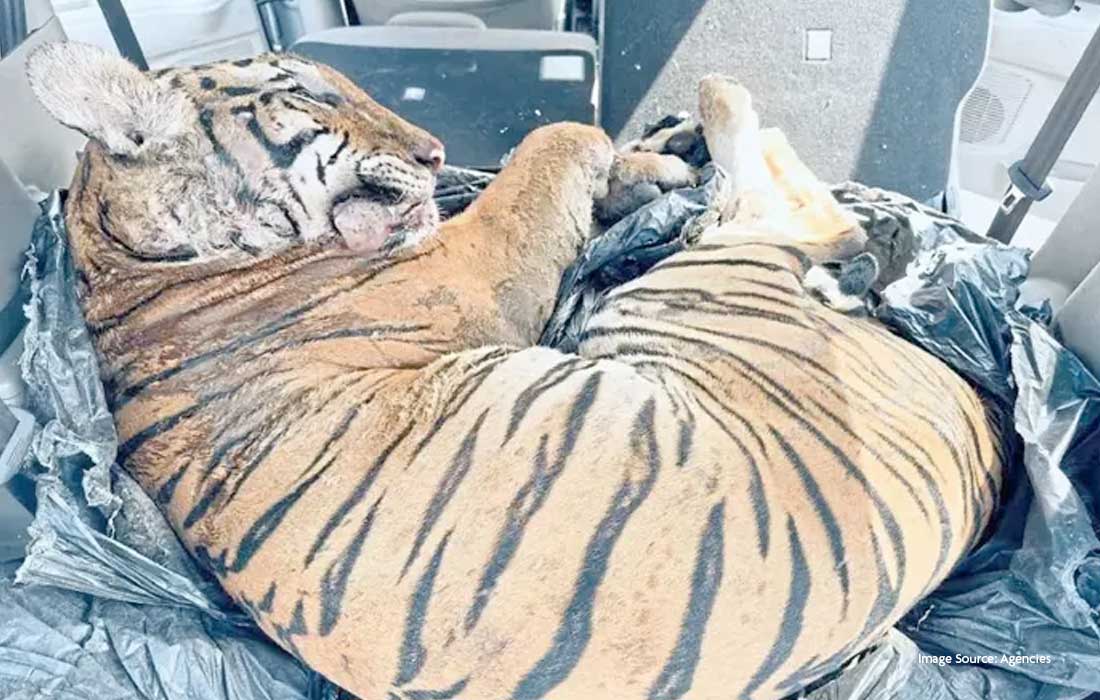

Fifty years after tigers gained the world’s highest level of international protection, the illegal trade in these iconic species is not slowing – it’s rampant and evolving.
GLOBAL: The illegal trade in wild tigers is intensifying, with criminal networks exploiting weaknesses in enforcement to traffic live animals and entire carcasses rather than just parts — posing a grave threat to tiger populations worldwide. A sweeping new review by TRAFFIC reveals a surge in seizures, underscoring how trafficking is evolving faster than global conservation efforts can respond.
Over the past 25 years — from 2000 until mid‑2025 — authorities worldwide recorded 2,551 seizure incidents involving at least 3,808 tigers. In just the last five years (2020–June 2025) there were 765 seizures, equivalent to 573 tigers — roughly nine every month.
Historically, traffickers focused on skins, bones and other tiger parts. But the latest data show a worrying shift: many seizures now involve whole tigers — alive or dead — hinting at growing demand for exotic pets, taxidermy, captive‑breeding supply lines, or whole‑animal trafficking.
This trend comes at a precarious time: from peaks of tens of thousands a century ago, the global wild tiger population is now estimated at just 3,700–5,500. Conservationists warn that if enforcement, legislation, and demand‑reduction efforts do not intensify rapidly, decades of protection — and recovery — could be undone.
The report calls for strong international cooperation, intelligence‑led enforcement, and reinforced legal frameworks across tiger‑range and consumer countries alike. Organisations working to stem the wildlife crime wave — including TRAFFIC and WWF — emphasise that tackling demand, closing legal loopholes, and mobilising multi‑agency efforts are essential.
To tackle the crisis, actions needed include: closing regulatory gaps across tiger‑range states; strengthening cross‑border law enforcement; global awareness campaigns to reduce demand for live tigers or their parts; and supporting habitat‑protection efforts for the remaining wild tiger populations.