
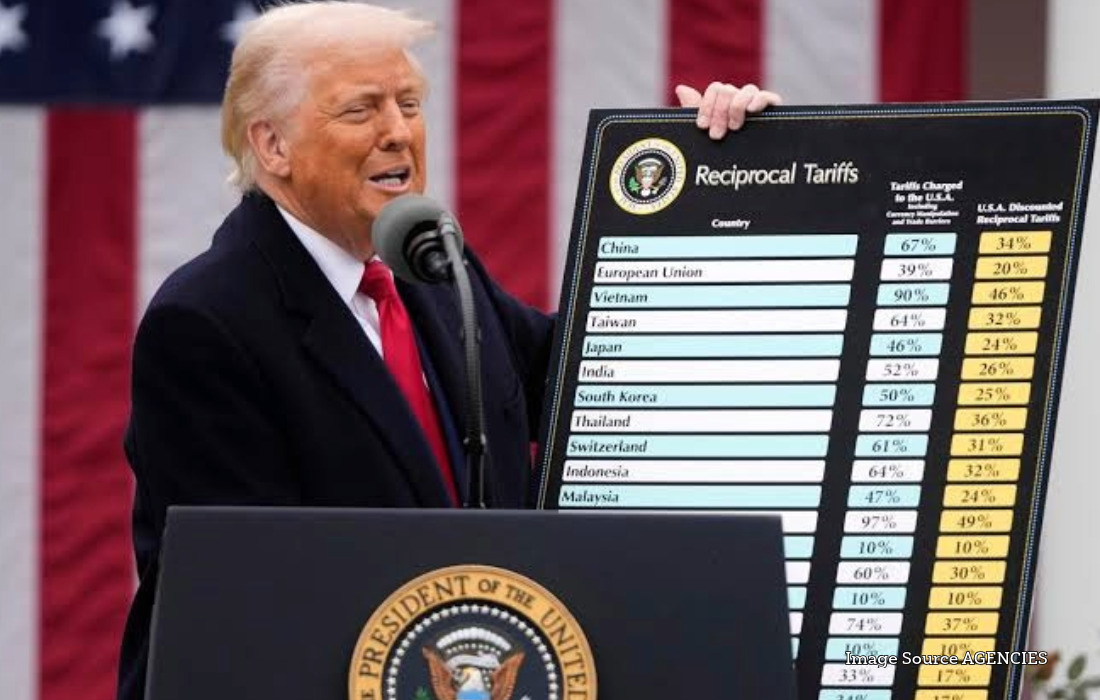

Trump tariffs could reshape global trade, disrupt supply chains and create economic challenges and new investment opportunities for GCC countries.
Donald Trump’s battle to reshape global trade has reached another milestone. On Wednesday, November 25, his administration announced it is targeting 14 major trading partners, including China, India, Japan, and the European Union, in a new tariff plan. He argued that these economies are producing more than global markets can absorb, thereby flooding international markets with cheap goods and undermining American manufacturing.
But what are the larger ramifications of this move? For one, we could see further fragmentation of the global economy. For decades, globalization encouraged countries to produce wherever it was most economical. Today, geopolitical considerations increasingly determine where goods are manufactured, how they are transported, and who buys them. That suggests we are moving gradually from an era of comparative advantage to one of strategic advantage.
There is another prism through which to view this development. The proposed tariffs also represent an attempt to rebuild the protectionist architecture that the United States Supreme Court partially dismantled earlier this year. It would also mean American consumers could end up paying more for imported goods, while businesses worldwide would have to contend with uncertainty, disrupted supply chains, and potentially retaliatory tariffs. We are in a blind spot on that part, as the full scale of world reaction, say countermeasures, remains to be seen.
Rambling in the ‘Middle’ East
On the face of it, the Middle East does not seem directly in the line of fire this time. However, it is unlikely to remain insulated from the economic consequences. None of the six GCC countries is among the 14 economies directly targeted by this latest set of proposals. However, that is hardly any solace, as their economic fortunes are closely intertwined with those of China, India, Europe, and, of course, the United States itself. The most obvious argument would be that any tariff-induced slowdown in global manufacturing and consumption could weaken oil demand. That, in turn, would pressurise government revenues and, potentially, ambitious economic diversification programmes.
That is not the only potential consequence. With countries such as the UAE and Saudi Arabia positioning themselves as global centres of trade, logistics, manufacturing, and investment, their economic transformation is premised on greater international connectivity. All that is playing out when the world appears to be moving toward greater economic fragmentation.
Opportunities galore
When trade is disrupted, can opportunities be far behind? The Gulf region could become an attractive alternative for manufacturers looking to diversify production bases. Infrastructure, taxation regimes, geographical proximity to major markets, and an expanding network of trade agreements could also help. The move makes the situation pregnant with possibilities. Chinese and other Asian goods facing barriers in American markets could find their way into the Middle East, benefiting consumers even if it intensifies competition for domestic manufacturers.
Here goes a more pertinent question:
Can the Middle East continue to maintain strong strategic relations with the United States while deepening economic integration with China and the rest of Asia? The answer is not simple, but I will try to simplify it anyway. So far, the Gulf has largely succeeded in keeping these relationships from becoming mutually exclusive. However, a prolonged global trade confrontation could make that balancing act increasingly difficult.