

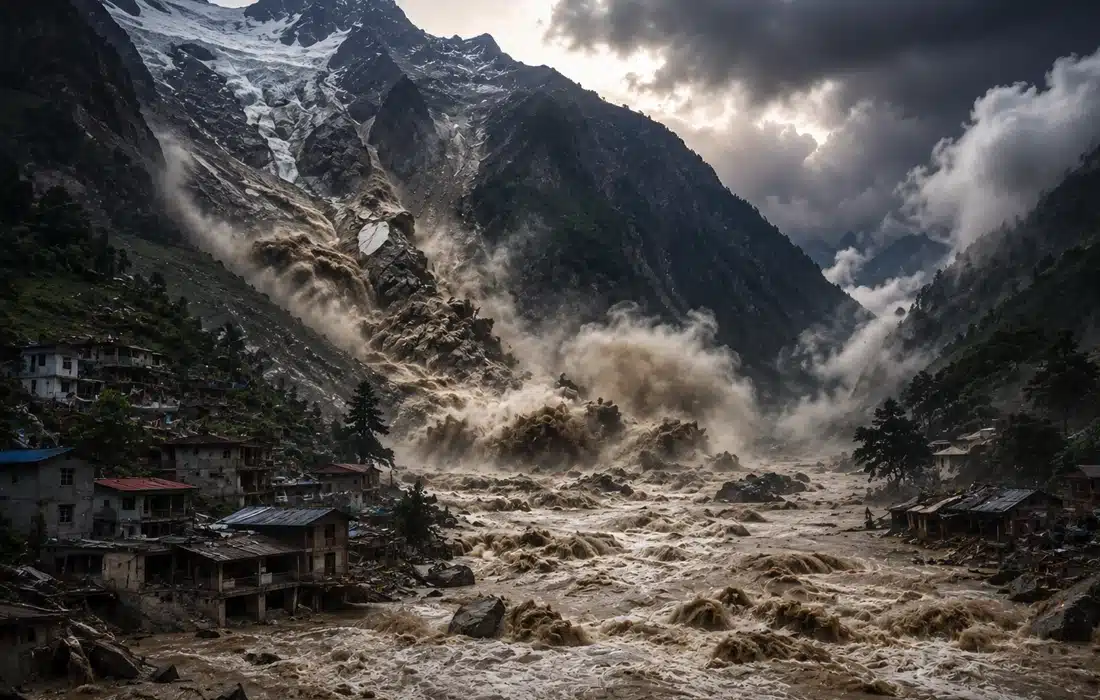

The Nepal flood cause appears linked to a huge Himalayan landslide that brought rock and glacial ice crashing into the valley below.
KATHMANDU: What caused the devastating floods in Nepal? A scientist says the Nepal flood cause can be traced high into the Himalayas, where a huge landslide sent rock and glacial ice crashing down a mountain and triggered a dangerous chain reaction.
Göran Ekström, a geophysicist at Columbia University’s Lamont-Doherty Earth Observatory, told ABC News that a large section of land broke away from a mountain pass on Wednesday. The falling section also had glacial ice sitting on top of it.
The collapse was enormous. According to Ekström, it released energy similar to a magnitude 5.2 earthquake and was strong enough to be picked up by earthquake monitoring equipment around the world.
Also read: Nepal flood rescue resumes as $5 billion rebuilding challenge emerges
As massive amounts of rock rushed down the mountain, they generated heat. This may have melted some of the glacial ice, adding even more water to the mixture of mud, rocks and debris moving downhill.
What followed was an extremely powerful flood. Ekström estimated that the water may have reached between 130 and 160 feet high in some places and could have travelled at speeds of around 44 miles per hour.
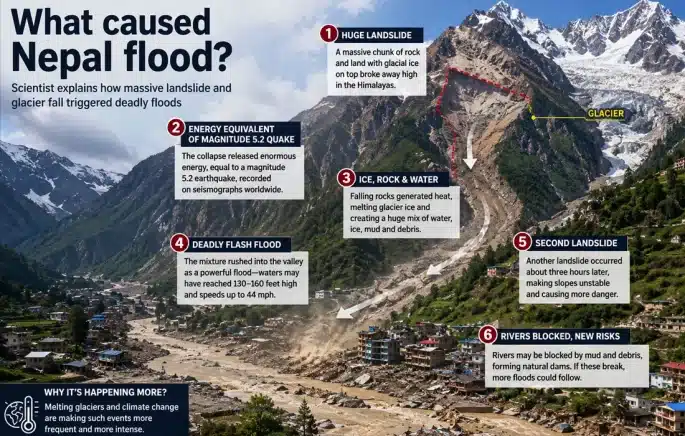
Another landslide happened about three hours later. Scientists are concerned that the first collapse may have made nearby slopes unstable, meaning further landslides remain a possible danger.
There is another risk. Mud, rocks and debris can block rivers and create temporary natural dams. Water can then collect behind them. If one of these blockages suddenly breaks, another rush of water could move downstream.
The Nepal flood cause has also raised fresh questions about changing conditions in the Himalayas. Ekström said events like this can happen naturally, but melting glaciers linked to climate change could make mountain areas more unstable.
Nepal has faced similar dangers before. On July 8, 2025, the Bhotekoshi river suddenly flooded after what authorities identified as a glacial lake outburst near the Nepal-China border.
Also read: Nepal flood disaster leaves hundreds dead as thousands remain missing
Scientists have identified thousands of glacial lakes across Nepal, India and Tibet. Research by the International Centre for Integrated Mountain Development and the United Nations Development Programme found 3,624 such lakes, with 47 considered potentially dangerous.
Perhaps most worrying is how difficult such disasters can be to predict. No forecast before Wednesday’s flood had warned that an avalanche would hit this particular location.
Impact to expect
People living around the Himalayas could face growing risks from unstable mountains, melting glaciers and sudden floods. Better monitoring of glaciers, lakes and mountain slopes could help authorities give communities more warning when dangerous conditions develop.