

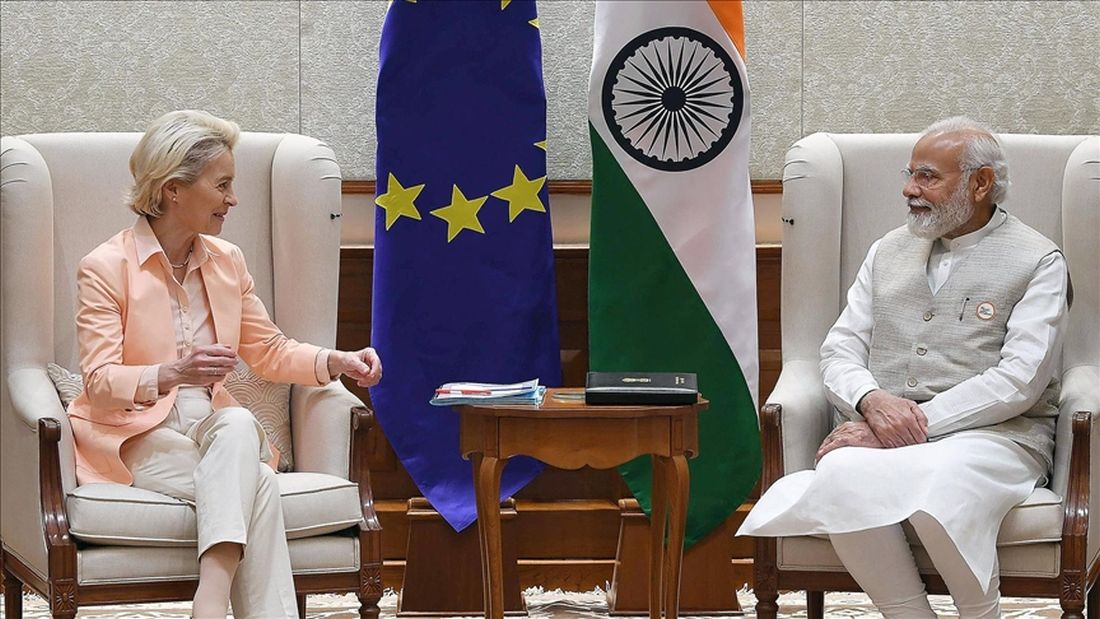

After nearly two decades of talks, India and the European Union signed a landmark free trade agreement — dubbed the “mother of all deals” — set to reshape global commerce by reducing tariffs on most goods and services, boosting investment and deepening strategic ties.
NEW DELHI: India and the European Union (EU) have reached a long‑awaited Free Trade Agreement (FTA) that leaders from both sides have described as “the mother of all deals”, marking a historic milestone for one of the world’s most strategic economic partnerships.
The agreement — concluded on 27 January 2026 after nearly 20 years of negotiations — links two of the world’s largest economies and aims to liberalise trade, investment and regulatory cooperation. It covers goods, services, and tariff reductions across a vast range of sectors, reflecting a modern, rules‑based framework designed to foster sustainable economic integration.
Under the pact, both India and the EU have agreed to cut or eliminate tariffs on an unprecedented share of traded goods. The EU will dramatically reduce duties on about 96–97% of its exports to India — including automobiles, machinery, pharmaceuticals, and premium goods — while India will drop tariffs on approximately 99.5% of its exports to the EU, opening up opportunities for industries such as marine products, textiles, chemicals, engineering goods, gems and jewellery.
With a combined population of nearly 2 billion people and accounting for roughly 25% of global GDP and one‑third of world trade, the deal is expected to catalyse economic growth on both sides. European Commission President Ursula von der Leyen called it a decision by “two giants” to deepen cooperation amid shifting global trade dynamics.
The FTA also includes an expanded framework for market access, investment protection, regulatory cooperation, and sustainable development commitments that go beyond tariff cuts to strengthen rules‑based commerce between India and the EU. Services trade — spanning finance, transport, technology, and professional sectors — will benefit from clearer rules and phased liberalisation aimed at facilitating cross‑border business expansion.
Economists and industry bodies project substantial opportunities for Indian exporters. The engineering sector alone could see exports to the EU rise to $25 billion in two years, while the gems and jewellery trade could double to $10 billion by increasing competitive access and reducing tariff barriers.
While sensitive agricultural products such as dairy, sugar and rice are excluded to protect domestic sectors on both sides, the deal still represents a major shift in global trade strategy — particularly as nations diversify away from concentrated dependencies amid rising tariff tensions elsewhere.
The FTA must now be ratified by the European Parliament, EU member states and India’s domestic procedures, with implementation expected by early 2027. If fully enacted, the pact will be one of the most significant trade deals of the decade, strengthening India‑EU economic ties, expanding market access, and setting a new benchmark for future bilateral trade agreements.